Robert Spencer

|

Pamela Geller

|

Bat Ye'or

|

Brigitte Gabriel

|

Daniel Pipes

|

Debbie Schlussel

|

Walid Shoebat

|

Joe Kaufman

|

Wafa Sultan

|

Geert Wilders

|

The Nuclear Card

Tag Archive | "Danios"

Tags: , , , , , , , , , , , , , , , , , , ,

Warrior Monks: The Untold Story of Buddhist Violence (I)

Posted on 29 July 2012 by Danios

This is a part of LoonWatch’s Understanding Jihad Series.

The basic plank of Islamophobia can be summed up as follows:

Islam is uniquely violent compared to other world religions.

Of course, it’s just not true.  In previous articles, I’ve taken a Thor-sized hammer to shatter this myth by proving that Judaism and Christianity are scripturally and theologically just as violent, if not more so.  The Bible is far more violent than the Quran, and both the Jewish and Christian traditions have been just as problematic.

It’s also not true from a historical perspective.

Take Judaism for instance:  According to the foundational narrative in the Bible, for instance, the Hebrews were persecuted in Egypt, forcing them to flee to Palestine.  When they found the Promised Land to be already occupied by the native Canaanites, Moses and the Jews invoked their warrior god to mercilessly slaughter the indigenous population in what can only be called a genocidal holy war.

The Jewish kingdoms were then overrun by outsiders.  Eventually, the Jews came under the rule of Antiochus IV Epiphanes, who sought to replace Judaism with his own religion.  The Jews revolted and overthrew him, leading to the emergence of the Jewish Hasmonean Dynasty.  Just previously facing down the barrel of religious oppression, the Jews did not lose a beat and immediately set out oppressing non-Jews.  By force of arms, they sought to expand their borders and to ethnically cleanse the land of infidels, either killing non-Jews, forcibly converting them to Judaism, enslaving them, or simply running them off the land.

This Jewish kingdom fell as well, and the Jews would have to wait until the twentieth century to rule again.  They faced several centuries of oppression and finally ethnic cleansing at the hands of the Nazis, but eventually regrouped in Palestine.  Just yesterday having chanted “never again!”, they seamlessly transitioned to the task of ethnically cleansing Palestine of its non-Jewish population.

Although it’s true that Jews have been on the receiving end of oppression for a great deal of history, it’s also true that they have oppressed when in a position of power.  Is oppression then a matter not of religion but simply of opportunity?

Christians had more opportunity for violence than any other religious group on earth, and it is therefore unsurprising that, from a sheer numbers perspective, they have been responsible for the most acts of warlike aggression than any other.  It is true that Jesus himself never engaged in violent action, but again, this seems to be an issue of opportunity rather than moral repulsion to violence: he was never in a position of political power and was in fact killed by the authorities.  But, according to the Biblical narrative, Jesus will return to earth as a conquering warrior king, flanked by a massive army of earthly and heavenly beasts.  He will then kill all his enemies.

The early Church was not pacifist as many modern-day Christians claim.  Instead, the early Church fathers enlisted themselves as prayer warriors for the imperial Roman armies.  The very minute Christianity rose to power with the conversion of the Roman Emperor Constantine, war in the service of empire and religion was adopted wholesale.  Once persecuted by pagans, Christians now set out to destroy paganism in Europe.  They sent forth armies to conquer new lands in the name of Christ.  Eventually, almost all of Africa, Australia, Europe, South and North America–as well as huge swaths of land in Asia–came under the boots of Christian soldiers.  Even today, the Religious Right in the U.S. leads the country down the path of war.

Not a single inhabited continent was spared by the Christian conquerors, so it is very difficult to accept the idea that Islam is somehow uniquely violent.

Of course, there is no denying that Islamic history had its fair share of violence.  Just as the Christian Church came under the tutelage of the Roman state, so too did many ulema ingratiate themselves to the rulers.  Expansion of the state was religiously justified, and the armies of Islam poured out of the Arabian Peninsula, conquering lands from China to Spain.

Islamophobes often complain that Islam gobbled up a significant part of the Christian world, which is true.  Yet, the Christians themselves had conquered these lands aforetime.  Is this simply not a case of Christians crying foul play when another religious group does to them what they did to the rest of the world?

It seems clear that Westerners of the Judeo-Christian tradition have no leg to stand on when they single out Islam.

But, what about Eastern religions, such as Buddhism?  Is violence merely a problem of the three Abrahamic faiths, as some would have us believe?

Westerners imagine a stark contrast between supposedly violent Muslims on the one hand and pacifist Buddhists on the other.  When we recently linked to a story about Buddhist oppression of the Muslim community in Burma, an Islamophobe quipped:

So, Buddhists acting like Muslims for once?

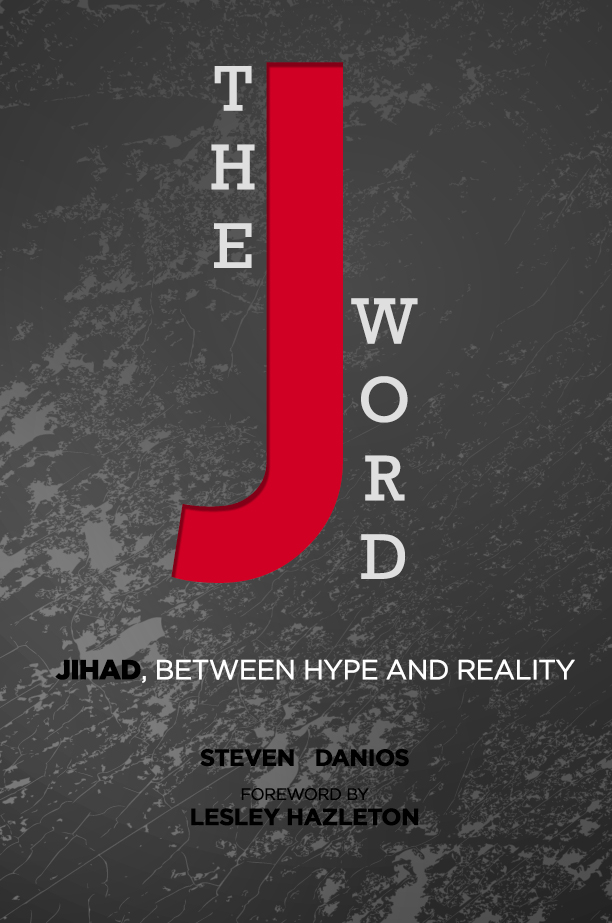
This remark reveals a profound ignorance of history.  Stereotypes notwithstanding, the Buddhist tradition is no stranger to violence.  This little known story is retold by Professors Michael Jerryson and Mark Juergensmeyer in the book Buddhist Warfare.  Jerryson writes:

Violence is found in all religious traditions, and Buddhism is no exception.  This may surprise those who think of Buddhism as a religion based solely on peace.  Indeed, one of the principal reasons for producing this book was to address such a misconception.  Within the various Buddhist traditions (which Trevor Ling describes as “Buddhisms”), there is a long history of violence.  Since the inception of Buddhist traditions 2,500 years ago, there have been numerous individual and structural cases of prolonged Buddhist violence. [1]

Prof. Jerryson writes in Monks With Guns: Discovering Buddhist Violence of armed Buddhist monks in Thailand.  He notes that the West’s romantic view of Buddhism

shield[s] an extensive and historical dimension to Buddhist traditions: violence. Armed Buddhist monks in Thailand are not an exception to the rule; they are contemporary examples of a long historical precedence. For centuries monks have been at the helm, or armed in the ranks, of wars. How could this be the case? But more importantly, why did I (and many others) hold the belief that Buddhism=Peace (and that other religions, such as Islam, are more prone to violence)?

He then answers his own question:

Buddhist Propaganda

It was then that I realized that I was a consumer of a very successful form of propaganda. Since the early 1900s, Buddhist monastic intellectuals such as Walpola Rahula, D. T. Suzuki, and Tenzin Gyatso, the Fourteenth Dalai Lama, have labored to raise Western awareness of their cultures and traditions. In doing so, they presented specific aspects of their Buddhist traditions while leaving out others.

It should be clear that such “propaganda” need not necessarily be construed as something sinister.  Proponents of other religions–including Judaism, Christianity, and Islam–will, for obvious reasons, often give a positive spin to their faith traditions.  Many Buddhists believe their history to be relatively peaceful, because they view their religion to be so.  This is no different than Muslims claiming that Islam is “the religion of peace”.

The difference is that the politics of the War on Terror have caused the religion of Islam to be put under heavy scrutiny.  Therefore, there is great incentive to refute Muslim “propaganda”, an incentive which simply does not exist for Buddhist “propaganda”.  The enemy, after all, is Muslim, not Buddhist.  Thus, Buddhism flies under the radar, and Buddhist “advertising” is taken at face-value.

Buddhism’s relative inconspicuousness shields it from the harshest blows of public criticism.  Case in point: the Bible and the Quran are well-known and easily accessible to the public.  Finding the violent verses in them is just a click away on the internet.  Meanwhile, Buddhist scriptural sources are more obscure, at least to the average Westerner.  Most people don’t even know what scriptures Buddhists follow, let alone what is contained within them.

As a consequence, many modern-day Buddhists believe that their scriptural sources are in fact devoid of violence, that this is a problem only of the Bible or the Quran.  But, Prof. Stephen Jenkins points out that this is just not the case.  In fact, ”Buddhist kings had conceptual resources [in the religious texts] at their disposal that supported warfare, torture, and harsh punishments.” [2]

For example, the Nirvana Sutra, a canonical Buddhist text, narrates a story about one of Buddha’s past lives: in it, he kills some Hindus (Brahmins) because they insulted the Buddhist sutras (scriptures):

The Buddha…said…”When I recall the past, I remember that I was the king of a great state…My name was Senyo, and I loved and venerated the Mahayana sutrasWhen I heard the Brahmins slandering the vaipulya sutras, I put them to death on the spot.  Good men, as a result of that action, I never thereafter fell into hell.  O good man! When we accept and defend the Mahayana sutras, we possess innumerable virtues.” [3]

Porf. Paul Demieville writes:

We are told that the first reason [to put the Brahmins to death] was out of pity [for them], to help the Brahmans avoid the punishment they had accrued by committing evil deeds while continuously slandering Buddhism. [4]

Here we arrive at a disturbing theme found in Buddhist thought: “compassionate killing”.  Killing is normally forbidden because it is done with evil intent (hatred, vengeance, etc.), but if it is done with “compassion”, it becomes something permissible, even praiseworthy.

The Buddhist does the unbeliever a favor by killing him, “an act of charity”:

In the Zen sect in Japan, they interpreted the argument for taking another’s life as “attempting to bring the other’s Buddha nature to life” (Buddha nature exists in virtually every living being), “by putting an end to the passions that lead astray…”

They make killing an act of charity. [5]

This is of course a disturbing belief to most of us.  As Prof. Bernard Faure puts it: “‘Killing with compassion’…remains a dubious oxymoron.” [6] One is reminded of the odd Christian belief that a Christian soldier can love his enemies even as he kills them.  Of what relevance is such “love”?

Jenkins writes:

If he does so with compassionate intentions, a king may make great merit through warfare, so warfare becomes auspicious. The same argument was made earlier in relation to torture, and the sutra now proceeds to make commonsense analogies to doctors and to parents who compassionately inflict pain in order to discipline and heal without intending harm. [7]

He goes on:

General conceptions of a basic Buddhist ethics broadly conceived as unqualified pacifism are problematic.  Compassionate violence is at the very heart of the sensibility of this sutra.  Buddhist kings had sophisticated and practical conceptual resources to support the use of force…The only killing compatible with Buddhist ethics is killing with compassion.  Moreover, if a king makes war or tortures with compassionate intentions, even those acts can result in the accumulation of vast karmic merit. [8]

There was a second reason to kill the infidels: to defend the Buddhist faith.  Prof. Demieville writes:

The Buddha’s second reason for putting them to death was to defend Buddhism itself. [9]

Faure notes:

Another oft-invoked argument to justify killing is the claim that, when the the dharma [i.e. the Buddhist religion] is threatened, it is necessary to ruthlessly fight against the forces of evil…promoting the need for violence in order to preserve cosmic balance… [10]

What about the first precept of Buddhism, which forbids murder?  Demieville writes:

In another passage, this same sutra (scripture) declares that there is no reason to observe the five precepts [the first of which is the taking of life], or even to practice good behavior, if protecting the Real Law is in question.  In other words, one needed to take up the knife and the sword, the bow and the arrow, the spear and the lance [to defend the faith].  ”The one that observes the five precepts is not a follower of the [Mahayana]!  Do not observe the five precepts–if it concerns protecting the Real Law…” [11]

The Nirvana Sutra reads:

The [true] follower of the Mahayana is not the one who observes the five precepts, but the one who uses the sword, bow, arrow, and battle ax to protect the monks who uphold the precepts and who are pure. [12]

The dye is cast for defense in the name of religion.  Elsewhere in the Nirvana Sutra, we are told of a king who goes to war in defense of rightly-guided monks:

To protect Dharma [Buddha's teachings], he came to the defense of the monks, warring against the evil-doers so that the monks did not suffer.  The king sustained wounds all over his body.  The monks praised the king: “Well done, well done, O King!  You are a person who protects the Wonderful Dharma.  In the future, you will become the indispensable tool of Dharma.” [13]

This king too was Buddha in a past life; Buddha declared:

When the time comes that the Wonderful Dharma is about to die out, one should act like this and protect the Dharma.  I was the king…The one who defends the Wonderful Dharma receives immeasurable recompense…

Monks, nuns, male and female believers of Buddha, should exert great effort to protect the Wonderful Dharma.  The reward for protecting the Wonderful Dharma is extremely great and immeasurable.  O good man, because of this, those believers who protect Dharma should take the sword and staff and protect the monks who guard Dharma

Even if a person does not observe the five precepts, if he protects the Wonderful Dharma, he will be referred to as one of the Mahayana. A person who upholds the Wonderful Dharma should take the sword and staff and guard monks. [14]

Demeiville notes:

Along these lines, the Buddha sings the praises of a king named Yeou-to, who went to war to defend the bhiksu (monks). [15]

The general idea is that “[h]eresy must be prevented and evil crushed in utero.” [16]

As for the Brahmins whom Buddha killed, they were in any case icchantika, those who neither believe in Buddha or Buddhism–historically, the Buddhist equivalent of infidel.  Buddha says in the Nirvana Sutra:

If any man, woman, Shramana, or Brahmin says that there is no such thing as The Way [i.e. Buddhism], Enlightenment, or Nirvana, know that such a person is an icchantika.  Such a person is one of [the demon] Mara’s kindred [Mara = the Lord of Death].  Such a person is not of the world… [17]

An icchantika is “sinful…[because] he does not act in accordance with the Bhuddas’ injunctions.” [18]  ”Because the icchantika lacks the root of good,” he “falls into hell.” [19] In fact, “it is not possible…for the icchantika not to go to hell.” [20] The icchantika is “the lowest” and “has to live for an eon in hell.” [21]

Putting to death unbelievers carries no sin or bad karmic result.  Demieville writes:

Regardless, these Brahmans were predestined to infernal damnation (icchantika); it was not a sin to put them to death in order to preserve the Real Law. [22]

There are in fact three grades of murder, in increasing order of seriousness, but killing infidels is not one of them.  The Nirvana Sutra reads:

The Buddha and Bodhisattva see three categories of killing, which are
those of the grades 1) low, 2) medium, and 3) high.  Low applies to the class of insects and all kinds of animals…The medium grade of killing concerns killing humans [who have not reached Nirvana]…The highest grade of killing concerns killing one’s father, mother, an arhatpratyekabudda, or a Bodhisattva [three ranks of Enlightenment]…

A person who kills an icchantika does not suffer from the karmic returns due to the killings of the three kinds above.  O good man, all those Brahmins are of the class of the icchantika.  Killing them does not cause one to go to hell. [23]

The Buddha says in the Nirvana Sutra that icchantika’s status is lower than that of the ants:

[T]he icchantikas are cut off from the root of good…Because of this, one may well kill an ant and earn sin for doing harm, but there is no sin for killing an icchantika.” [24]

In addition to issues of faith and unbelief, the Buddhist tradition offered sophistic justifications for killing and war:

[H]ow can one kill another person when…all is emptiness?  The man who kills with full knowledge of the facts kills no one because he realizes that all is but illusion, himself as well as the other person.  He can kill, because he does not actually kill anyone.  One cannot kill emptiness, nor destroy the wind. [25]

Furthermore, killing is sinful because of the evil it creates inside the killer’s mind.  But, a true yoga master can train his mind to be “empty” even while he kills.  If the killer has “vacuity” of thought, then the murder “did not undermine the essential purity of his mind” and then there is nothing wrong with it. [26] In other words, killing can be excused if it is done by the right person, especially a “dharma-protecting king”.

The Buddhist canonical and post-canonical texts not only provide the religious justifications for war and killing, but provide examples of meritorious holy figures who engaged in it, examples for all Buddhists:

Celestial bodhisattvas, divinized embodiments of the power of enlightened compassion, support campaigns of conquest to spread the influence of Buddhism, and kings vested with the dharma commit mass violence against Jains and Hindus. [27]

In these textual sources, we see dharma-inspired Buddhist kings who “have a disturbing tendency for mass violence against non-Buddhists.” [28]

Buddhist Warfare provides many other examples of the theological justifications for waging war and killing, but these shall suffice us for now: they provide the religious basis for Buddhist holy war: (1) Killing those who slander Buddhism as a necessity; (2) Anyone who rejects Buddhism is by default slandering it; (3) Killing infidels carries no sin; (4) In fact, it is not really killing at all.

These are not merely theoretical justifications found buried in religious texts.  Instead, these beliefs were acted upon historically, and continue to be so in the contemporary age.  The historical record is something we will explore in part II.

*  *  *  *  *

Disclaimer:

Prof. Michael Jerryson issues the following disclaimer:

Our intention is not to argue that Buddhists are angry, violent people—but rather that Buddhists are people, and thus share the same human spectrum of emotions, which includes the penchant for violence.

I could not agree more with Jerryson here.  My intent here is not to demonize Buddhism, but rather, to underscore the reality that all religious traditions, not just Islam, have had their fair share of violence.  This includes Buddhism.

It’s certainly something uncomfortable for me criticizing a religious tradition in this way, but it seems necessary to dispel the enduring myth that Islam holds a monopoly on violence.

I would also like to take this opportunity to distance myself from those who are using the violence in Burma to further Buddhaphobia.  Such claim that “people are ignoring what is happening to Muslims in Burma”, which is certainly true, but we all know that if the shoe were on the other foot–if it were Muslims in Burma oppressing Buddhists–then many of these Muslims would be the silent ones, or even be justifying such oppression (as I have seen many Buddhists doing now).

What is it other than rancid hypocrisy when some Pakistanis are up in arms about Muslims in Burma, but absolutely silent about the oppression of religious minorities in their own country?

How easily these people are able to transfer the same hatred against Islam that is directed toward them on a daily basis to Buddhism!

What I have learned about religions is the following:

#1: Adherents of a religion will cry foul when their coreligionists are the victims of oppression, but will remain silent or even justify such oppression when their coreligionists are the perpetrators of such oppression.  This includes Jews, Christians, Buddhists, and Hindus–as well as Muslims.

To this, I recall the words of the Prophet Muhammad, who said: “Help your brother, whether he is an oppressor or he is oppressed.”  The people asked him: “It is right to help him if he is oppressed, but how we should help him if he is an oppressor?”  Muhammad replied: “By preventing him from oppressing others.”

#2: The corollary to #1 is that religious groups will cry foul when they are oppressed by another religious group, but as soon as they themselves come to power, the very next minute they set to the task of oppressing the religious other.  Yesterday, the Jews were ethnically cleansed by the Nazis; today, they ethnically cleanse the Palestinians.  It is such a seamless transition–it happens with such mechanistic automatism and absolute obliviousness–that it is something quite amazing to witness.

#3: Following from #2, it becomes obvious that humans oppress when they are given the opportunity to do so.  It is not their religious creed that matters so much but rather whether they have opportunity or not.

#4: No major world religion is vastly different from the other when it comes to its propensity to inspire violence.

#5: Instead of using religious violence to demonize particular faiths–instead of using it as a battle ax to split open heads–we should hold in our hearts a continuous candlelight vigil to end inter-religious violence–holding hands with Jews, Christians, Muslims, Buddhists, Hindus–and start seeing each other as fellow human beings.

Danios was the Brass Crescent Award Honorary Mention for Best Writer in 2010 and the Brass Crescent Award Winner for Best Writer in 2011.

Footnotes:
[1] Jerryson, Michael K., and Mark Juergensmeyer. Introduction. Buddhist Warfare. Oxford: Oxford UP, 2010. 3. Print.
[2] Jenkins, Stephen. “Making Merit through Warfare and Torture.” Buddhist Warfare. By Michael K. Jerryson and Mark Juergensmeyer. Oxford: Oxford UP, 2010. 59. Print.
[3] Nirvana Sutra, Chapter 19.
[4] Demieville, Paul. “Buddhism and War.” Buddhist Warfare. By Michael K. Jerryson and Mark Juergensmeyer. Oxford: Oxford UP, 2010. 41. Print.
[5] Ibid., 44.
[6] Faure, Bernard. “Afterthoughts.” Buddhist Warfare. By Michael K. Jerryson and Mark Juergensmeyer. Oxford: Oxford UP, 2010. 212. Print.
[7] Jenkins, 68.
[8] Ibid., 71.
[9] Demieville, 41.
[10] Faure, 212.
[11] Demieville, 41.
[12] Nirvana Sutra, Chapter 5.
[13] Ibid., Chapter 19.
[14] Ibid.
[15] Demieville, 41.
[16] Ibid., 39.
[17] Nirvana Sutra, Chapter 22.
[18] Ibid., Chapter 24.
[19] Ibid., Chapter 34.
[2o] Ibid., Chapter 39.
[21] Ibid., Chapter 40.
[22] Demieville, 41.
[23] Nirvana Sutra, Chapter 22.
[24] Ibid., Chapter 40.
[25] Faure, 213.
[26] Demieville, 42.
[27] Jenkins, 59.
[28] Demieville, 63.

Comments (125)

Tags: , , , , , , , , , ,

Louie Gohmert: “You See Me Huggin’ Muslims Around The World”

Posted on 23 July 2012 by Danios

Subtle Islamophobia has been a part of U.S. national discourse for a very long time, but up until recently, the rabid, vitriolic, and out-in-the-open form of anti-Muslim hysteria of the cyber-world was limited to websites like Jihad Watch.  This is no longer the case, as it has now infiltrated the United States government, exactly the opposite of what anti-Muslim loons claim, i.e. that “stealth jihad” and “sharia” have infiltrated the government.

First, there was Congressman Peter King, Chairman of the House Homeland Security Committee, who planned and held anti-Muslim Congressional hearings–not once, not twice, not three times, not four times, but five times!

Then, there were accusations of disloyalty and “stealth jihad” against the only two Muslim Congressmen in office.

To better approximate the McCarthyism of the 1950′s, five House Republicans have now claimed that the sinister Muslim Brotherhood has “penetrated” the U.S. government and that “officials in highly sensitive positions inside the United States government” are linked to the Brotherhood.  The group sent letters to five federal agencies demanding an investigation.

Such a wacky conspiracy theory is par for the course for loony sites like Robert Spencer’s Jihad Watch and Pamela Geller’s Atlas Shrugs.  But, to see such nuttiness in the mainstream is truly frightening, and a testament to the persistent campaign of Islamophobia waged by online anti-Muslim crusaders.

The congressional charge is led by Rep. Michele Bachmann, a veritable Islamophobe who absolutely hates Muslims.  Other members of the Islamophobic gang include Reps. Trent Franks, Thomas Rooney, Lynn Westmoreland, and Louie Gohmert.

The quintet pointed the finger at Huma Abedin, deputy chief of staff and aide to US Secretary of State Hillary Clinton: she was linked to the nefarious Muslim Brotherhood.  This led to a critical response by John McCain, who came to Abedin’s swift defense.  He thundered:

Ultimately, what is at stake in this matter is larger even than the reputation of one person.  This is about who we are as a nation, and who we still aspire to be.

When anyone, not least a member of Congress, launches specious and degrading attacks against fellow Americans on the basis of nothing more than fear of who they are and ignorance of what they stand for, it defames the spirit of our nation, and we all grow poorer because of it.

But, McCain himself is guilty of smearing an influential Muslim with the Muslim Brotherhood smear: he blithely declared that Mohamed ElBaradei, Nobel Laureate and former Director General of the U.N.’s International Atomic Energy Agency (IAEA), “could be a figure hood for the Muslim Brotherhood.”  The difference between Abedin and ElBaradei is that the former is a part of America’s elite political class whereas the latter is just some foreigner.  It will be interesting to see, however, which of the two trumps the other: Abedin’s Muslimness or her eliteness?

Andrew McCarthy, formerly the Assistant United States Attorney for the Southern District of New York (who prosecuted several high profile terrorism cases) and currently a columnist for the National Review, slammed John McCain on the same grounds.  He quipped:

…Senator McCain is no stranger to smear. No need to confirm that with Mr. ElBaradei…

But, Andrew McCarthy has a different angle in mind: he actually writes this article in defense of the five Republicans and against Huma Abedin.  In fact, it is a five page screed in support of wild Islamophobic conspiracy theory, of the “Obama-administration['s] coziness with the Muslim Brotherhood.”  (Is it a wonderful coincidence that his last name is McCarthy?)

Andrew McCarthy’s apologia aside, Rep. Louie Gohmert came to his own defense:

Of course, Gohmert’s “you see me huggin’ Muslims around the world” is as absurd as Pamela Geller’s “I love Muslims”.

But, the money quote is actually by Janet Napolitano, the United States Secretary of Homeland Security, who said:

What bothers me, quite frankly, are the allegations that are made against anyone who happens to be Muslim.

This powerful sentence succinctly summarizes the status quo: if you are Muslim, you will be smeared.  You will somehow be linked to the Muslim Brotherhood, which in turn, will be linked to Hamas.  You will then be referred to as the “Hamas-linked so-and-so.”  That is the standard Islamophobic smear and it is hurled against any Muslim individual (or group) who gains even nominal prominence.

The irony, of course, is that Janet Napolitano is the Secretary of Homeland Security, which is overseen by the U.S. House Committee on Homeland Security–yes, the same committee that led the anti-Muslim hearings.  There is an Islamophobia circus going on right now, and the venue for this circus has moved from anti-Muslim blogs to the halls of government.

Danios was the Brass Crescent Award Honorary Mention for Best Writer in 2010 and the Brass Crescent Award Winner for Best Writer in 2011.

Comments (5)

Tags: , , , , , , , ,

Why I Support Jill Stein for President of the United States

Posted on 14 July 2012 by Danios

(Note: This is my personal opinion, and does not necessarily reflect the views of LoonWatch overall.)

LoonWatch stands for peace, tolerance, and mutual understanding.  It is no surprise then that I would support Dr. Jill Stein of the Green Party for President of the United States.   She embodies the virtues and principles that guide our website; more importantly, she represents the best of our nation’s tradition.

For those of you who don’t know her, Jill Stein is a Harvard-educated physician and activist from Lexington, Massachusetts.  She has been involved in politics for over a decade.  Dr. Stein just won the presidential nomination for the Green Party, perhaps the most well-known third party in the country.  Although a long-shot, she would be the first Jew and woman to be President.  More importantly, she is one of the only peace-loving candidates running for office.  She strongly opposes America’s wars and military occupations in the Muslim world, which are both the cause and result of Islamophobia.  She wants to put an end to the militarism which has defined our nation for at least the last decade.

The Republican Party has been taken over by hate- and war-mongers.  But, the Democratic option has failed us miserably over the course of the last four years.  President Barack Obama has expanded the misguided “War on Terror”, which is not just the cause and result of Islamophobia, but is itself responsible for causing more terrorism than anything else.  Obama has in fact done nothing but establish bipartisan consensus towards the Bush/Cheney world view.

In the past, I’ve spoken favorably of Ron Paul’s foreign policy views.  To be sure, Dr. Paul should be credited for bringing national attention to this matter, if but fleetingly.  But, the libertarian candidate’s opposition to the wars is based more on Constitutional procedure than moral fortitude, more on financial necessity than humanitarian concern.  While opposing U.S. military intervention in Iraq and Iran, for instance, Paul seems to have no problem with an Israeli attack on both of these countries.  Jill Stein, on the other hand, opposes such warmongering on moral grounds, no matter who engages in it.

Not surprisingly, Stein’s domestic views are much more in line with my progressive politics than Paul’s.  We should be investing more in social welfare, healthcare, education, and the environment, not less.  In fact, by de-funding America’s wars and military, the U.S. can easily afford to focus on these sectors.  (Additionally, Jill Stein has not sullied herself like Ron Paul has with racist newsletters.)

From a moral standpoint, there is no question that Jill Stein is the superior candidate.  There is an argument to be had about practicality and the utility of voting for a third party in a system that makes it virtually impossible for anyone other than a Democrat or Republican (the difference between Coke and Pepsi) to win.  Surely, progressives living in non-swing states should vote with their hearts and choose Jill Stein.

But, what about swing states? Is there an argument to be had that the Republican side is just so extreme that Barack Obama must be selected as the lesser of two evils?  My personal opinion is that the last four years have proven this argument, logical though it is, false.  At least when a Republican was in power, the “progressives” in the Democratic party opposed many of the more extreme measures in the War on Terror.  With the ascension of one of their own to power, even this feeble protest has died.

Furthermore, when it comes to Barack Obama and Mitt Romney, is there really any substantive difference when it comes to their warrior credentials?  Democrats and Republicans merely disagree on which Muslim countries to bomb (Afghanistan vs. Iraq), but they all agree on bombing some Muslim countries.  When it comes to the general contours of the War on Terror narrative, there is bipartisan consensus–which is exactly why I look to a third party now.

Nonetheless, I am open to discussion of the question (should those in swing states vote for Obama as a means of choosing the lesser of two evils?) from a purely tactical standpoint, and I could be swayed in the other direction.  For now, however, Jill Stein has both my heart and my ballot.

Danios was the Brass Crescent Award Honorary Mention for Best Writer in 2010 and the Brass Crescent Award Winner for Best Writer in 2011.

Comments (50)

Tags: , , , , , , , , , , , ,

Ayaan Hirsi Ali’s Hateful Quote Makes Its Rounds on Facebook

Posted on 29 June 2012 by Danios

The Global Secular Humanist Movement (GSHM) Facebook page recently posted this drivel from Ayaan Hirsi Ali:

To back this claim, GSHM linked to a 2007 MSNBC article with the propagandistic title of Some young U.S. Muslims approve suicide hits, which in turn cited a Pew study that found that “[o]ne in four younger U.S. Muslims say suicide bombings to defend their religion are acceptable at least in some circumstances.”

This Facebook post is now making its rounds around the internet.  Seeing as how LoonWatch monitors anti-Muslim loons–and Ayaan Hirsi Ali is among the best of them–I thought a response would be worthwhile.

First of all, it should be noted that suicide bombing by itself is not illegal under international law.  In a section entitled “Suicide Attacks and International Law”, Human Rights Watch (HRW) notes that “[s]uicide attacks are a method of warfare that in themselves do not violate the laws of war.”  This is the case if the tactic is used by legitimate combatants against purely military targets in a time and place of war.

In fact, HRW finds that “as weapons [suicide attacks] are very discriminate: a suicide bomber is able to detonate with an accuracy that exceeds that of the most sophisticated guided weapon.”  An Iraqi resistance fighter would inflict far fewer civilian casualties from a suicide attack against a U.S. military installation than a U.S. bomber would inflict from carpet bombing Iraqi cities.  But because U.S. soldiers are the victims of suicide bombing and not carpet bombing, Americans hold the former as the epitome of evil and the latter as perfectly acceptable: hey, it’s war!

The American mentality is very easy to understand: they suicide attack our soldiers, so it’s terrorism and morally atrocious.  We carpet bomb them, so it’s perfectly acceptable: what do you expect in a time of a war?

Forget just carpet bombing: “A Gallup poll in August [of 1945] revealed that 85 percent [of Americans] approved of the use of the atomic bomb against Japanese cities.”  In fact, a poll for Fortune magazine found that another “22.7 percent of respondents agreed with the sentiment: ‘We should have quickly used many more of the [atomic] bombs before Japan had a chance to surrender.’”  Worse yet, a “December 1944 Gallup poll found that 13 percent of respondents favored the killing of all Japanese” after the war: men, women, and children; or, in the words of the chairman of the U.S. government agency the War Manpower Commission, “[t]he extermination of the Japanese in toto.”  (All quotes in this paragraph taken from pp.13-14 of Prof. Sahr Conway-Lanz’s Collateral Damage.)

This is not just some sentiment of a bygone era.  To this day, a “majority of Americans surveyed think dropping atomic bombs on Japan during World War II was the right thing to do.”  I guarantee you that a sizable portion of Americans, if polled today, would agree with nuking Mecca, Medina, and/or Tehran.  Even more would be comfortable with carpet bombing Muslim cities, which is what our military already does.

That such sizable percentages of Americans support carpet and atomic bombings should really cause us to understand Pew’s poll results–and Ayaan Hirsi Ali’s rantings–with some much-needed perspective.

What MSNBC’s article, Ayaan Hirsi Ali’s quote, and the Global Secular Humanist Movement’s posting, fail to mention is that an even greater percentage of Americans–of many different religions or no religion at all–justify the targeting and killing of civilians.  This is something I pointed out in an earlier article of mine: Gallup Poll: Jews and Christians Way More Likely than Muslims to Justify Killing Civilians.  This showed that an overwhelming majority of U.S. Muslims (78%) stated that it is never morally justifiable to target and kill civilians, compared to only 38% of Protestants, 39% of Catholics, 43% of Jews, 33% of Mormons, and 56% of people with no religion/atheists/agnostics:

The wily Islamophobes feebly argued back, saying:

The survey is of American Muslims, who are unlikely to be representative of Muslims in Muslim countries or of Muslims in Europe.

To this, I published a follow-up article: Surveys Show Muslims in Every Country Less Likely to Justify Killing Civilians than Americans and Israelis.  In it, we saw the following results:

Percentage of people who said it is sometimes justifiable to target and kill civilians:

Mormon-Americans 64%
Christian-Americans 58%
Jewish-Americans 52%
Israeli Jews 52%
Palestinians* 51%
No religion/Atheists/Agnostics (U.S.A.) 43%
Nigerians* 43%
Lebanese* 38%
Spanish Muslims 31%
Muslim-Americans 21%
German Muslims 17%
French Muslims 16%
British Muslims 16%
Egyptians* 15%
Indonesians* 13%
Jordanians* 12%
Pakistanis* 5%
Turks* 4%

*refers to Muslims only

Of course, the Global Secular Humanist Movement will quickly put up its hands and say: “But, we’re atheists!”  To this, I point out that U.S. Muslims were much more likely to say attacks against civilians are never justifiable (78% vs. 56%).  Aren’t these “secular humanists” beholden to scientific means?  Why then don’t they mention in their posting the results from the control group(s)?  Doing so would of course nullify their thesis.  The fact that U.S. Muslims are more likely to condemn attacks aimed against civilians completely negates their argument that wow, look at how many Moozlums support suicide attacks!

Anti-Muslim ideologues always link present day Muslim violence to Islamic scripture: the implication is that such a sizable percentage of young Muslims believe in suicide bombing because of their religion.  In fact, the opposite holds true: these young Muslims believe in suicide bombing in spite of their religion.

Indeed, such a large percentage of Muslims abhor the targeting and killing of civilians because of their religious canon, which–unlike the Jewish and Christian counterparts–condemns such a thing.  Whereas Moses in the Bible orders his soldiers to “kill all the boys[] and kill every woman” (Numbers 31:17), Muhammad explicitly forbade targeting civilians on numerous occasions, saying:  “Do not kill an infirm old man, an infant, a child, or a woman.” (Sunan Abu Dawood, book 14, #2608)

The Quran also forbids suicide, which is why the overwhelming majority of Muslims oppose suicide bombing, even against purely military targets.  Admittedly, it is true that there exists a debate in some Muslim circles about the morality of suicide attacks against both soldiers and civilians.  However, it is very simplistic to draw the following conclusion:

X percent of Muslims say suicide bombing is sometimes justifiable.  If there exist Y number of Muslims, then that’s a lot of suicide bombers!

This is an erroneous and hasty conclusion.  Rather, X percent of Muslims stating that suicide bombing is sometimes morally justifiable is often simply a manifestation of their sympathies and solidarity with Muslims fighting occupation, specifically Palestinians.  The MSNBC article reads:

…Radwan Masmoudi, president of the Washington-based Center for the Study of Islam and Democracy…said most supporters of the attacks likely assumed the context was a fight against occupation — a term Muslims often use to describe the conflict with Israel.

Many of these Muslims may fear that condemning such tactics entirely would rob the resistance fighters of their moral high-ground.  It does not mean that they themselves will go out and suicide bomb, no more than it would mean based on the poll results above that an average American would go out and start shooting Muslim civilians.

That a small but sizable portion of Muslims would justify Palestinian attacks on Israeli civilians in the Occupied Territories may sound horrifying, but it ought to be understood in perspective: American and Israeli Jews are more likely to justify targeting and killing civilians (see results above).  Disturbingly, a survey conducted by Haifa University’s Center for the Study of National Security found that a majority of Israeli Jews support a policy of ethnic cleansing against Palestinians.

To this day, Americans debate the morality of the U.S. atomic bombing of Hiroshima and Nagasaki, with an unsettling majority of them thinking these attacks to be justified.  It would not surprise me if some American readers of our site would go on to justify atomic bombing of Japan in the comments section below.

To be perfectly clear, I find both suicide bombing and atomic bombing to be morally repugnant.  But, atomic bombing is more atrocious by an order of magnitude: it is the ultimate indiscriminate weapon of mass destruction.  A minority of Muslims thinking that suicide bombing is sometimes morally justifiable is hardly as worrisome as a majority of Americans thinking that atomic bombing is perfectly morally justifiable.

*  *  *  *  *

Ayaan Hirsi Ali’s quote can be further criticized for focusing on Muslims in only one decade of life (aged 18 to 29).  One could easily inflate the number of Christian, Jewish, or atheist/agnostic Americans who believe that targeting and killing civilians is permissible by focusing on that demographic with the highest results.  For example, older Americans are more likely to think this way, meaning those percentages would be even higher.

As the MSNBC article itself notes, “nearly 80 percent of U.S. Muslims say suicide bombings of civilians to defend Islam can not be justified, 13 percent say they can be, at least rarely.”  That 13% pales in front of the 58% of Protestants, 58% of Catholics, 52% of Jews, 64% of Mormons, and 43% of people with no religion/atheists/agnostics who argue that it is sometimes morally acceptable for the military to target and kill civilians.

As I wrote in my earlier article:

Of course, it would be worthwhile to consider actual results on the ground: we Americans have (at minimum, using conservative numbers) killed 30 times as many Muslim civilians as Muslims have killed of ours, whereas Israelis have killed many-fold the number of civilians as Palestinians have killed of theirs.  Clearly, what people and states do is far more relevant than what they merely believe.

Lastly, I would like to close with a message to the Global Secular Humanist Movement: shame on you for promoting an anti-Muslim demagogue and hatemonger like Ayaan Hirsi Ali.  It is the equivalent of posting up a quote by David Duke on Judaism.  But of course, the GSHM would find it very easy to levy attacks against an embattled minority in the U.S. (Muslims), but would never dare upset Jewish people in the same way.  Muslims are easy targets; GSHM knows that if it did the same thing to Jews, it “would get f*@king buried.”

Religious tolerance is a key feature of secular, liberal democracy in the American tradition.  Although I am not one to engage in nationalistic tribalism, I do deeply admire my country’s legacy of religion-friendly secularism, which stands in stark contrast to the religion-hostile (and un-American) French-style secularism.  Indeed, this latter style of secularism was born out of, and led to, an orgy of violence.  Intolerant secularists like Ayaan Hirsi Ali and the Global Secularist Humanist Movement emulate the religious intolerance they supposedly decry.  One can hardly tell the difference between the rantings of “secularist” Ayaan Hirsi Ali and Christian Islamophobes; in fact, one will find the two routinely sharing notes and being very cozy with one another.  Case in point: GSHM’s quote of Ayaan Hirsi Ali has become very popular among Christian Islamophobic circles.  New Atheists like Sam Harris and Christopher Hitchens lost all their credibility by jumping on the Islamophobic bandwagon; GSHM loses its credibility by posting Ayaan Hirsi Ali’s hateful screed.

Perhaps GSHM has taken up Ayaan Hirsi Ali because, as noted in yesterday’s featured article, “Ayaan Hirsi Ali (an exmuslim) has replaced Hitchens as the one of the Four Horsemen of New Atheism.”  The truth is that she can hardly be considered a horseman: she’s just an ass.  Ironically but unsurprisingly, it is asses like Ayaan Hirsi Ali who do more to undermine the cause of secularism and liberal democracy in the Muslim majority world than anybody else.  But more on that another time.

Danios was the Brass Crescent Award Honorary Mention for Best Writer in 2010 and the Brass Crescent Award Winner for Best Writer in 2011.

Comments (85)

Tags: , , , , , , , , , , , , , , , , , ,

Most Victims of Islamic Terrorism are Muslims… And Why America is to Blame For It

Posted on 18 June 2012 by Danios

(Updated – see below)

Following the 9/11 attacks, President George Bush signed into law the Patriot Act and the Intelligence Reform and Terrorism Prevention Act (IRTPA), both of which gave “the government sweeping authority to spy on individuals inside the United States.”  IRTPA also established the National Counterterrorism Center (NCTC), which began publishing annual terrorism reports since 2005.  The 2011 report, released to the public last week, ominously warned of “the persistent treat terrorism poses.”

Yet, the NCTC’s own data belies its predetermined conclusions: the threat of terrorism to the average American is virtually non-existent.  In the entire year of 2011, exactly zero civilians in the U.S. were killed by terrorism.  In fact, not a single civilian in the U.S. has been killed by Islamic terrorism since 9/11, well over a decade ago.  Put another way: more Americans are killed from being crushed to death by their television sets than by terrorism, a realization that should put “the persistent threat” of terrorism into some much-needed perspective.

The same is the case across the pond: Europol has released yearly terrorism reports since 2006.  Going through these, one cannot find a single civilian in Europe who has been killed by Islamic terrorism.  (It should be noted, however, that the as of yet unreleased 2012 report will no doubt reflect the Toulouse shootings, which resulted in the death of four civilians.)  Indeed, the truth is that less than 1% of terrorism in Europe is done by Muslims.

In other words, the threat of Islamic terrorism in the Western world is very minimal.  It has been grossly exaggerated in order to justify the multiple wars being waged in Muslim majority countries.  The charge is led by anti-Muslim ideologues, but the overarching premise–that Islamic terrorism is a great threat to Western civilization (even an existential threat to it)–is accepted by virtually all segments of American society.

*  *  *  *  *

Not only do Muslims inflict zero civilian deaths in America and Europe, they bear the brunt of terrorism in the Middle East and South Asia.  The 2011 NCTC report found that the vast majority of deaths from religious terrorism were in fact Muslims.  The report reads:

• In cases where the religious affiliation of terrorism casualties could be determined, Muslims suffered between 82 and 97 percent of terrorism-related fatalities over the past five years.

• Muslim majority countries bore the greatest number of attacks involving 10 or more deaths, with Afghanistan sustaining the highest number (47), followed by Iraq (44), Pakistan (37), Somalia (28), and Nigeria (12).

• Afghans also suffered the largest number of fatalities overall with 3,245 deaths, followed by Iraqis (2,958), Pakistanis (2,038), Somalis (1,013), and Nigerians (590).

The bulk of these terrorist attacks were carried out by Sunni extremists, including Al-Qaeda and the Taliban (see p.11 of the report).

Based on these two facts–1) that Muslims are the number one victims of Islamic terrorism, and 2) that Sunni extremists such as Al-Qaeda and the Taliban are most responsible for this—the American mind, fully ensconced in the national mythology, reaches the conclusion that Muslims ought to support America’s War on Terror; or, worded in an even more imperial tone:

Muslims should be grateful to us for fighting for them against the Bad Guys.

And yet, grateful is the last word to describe Muslim sentiment.  Muslims around the globe (including in Afghanistan and Iraq), overwhelmingly disapprove of the so-called War on Terror.  In fact, they hold very negative views of the United States (at least in regard its foreign policy), viewing “‘U.S. interference in the Arab world’ as the greatest obstacle to peace and stability in the Middle East.”  This, in spite of the majority holding very negative views towards Al-Qaeda and its tactics.

So, why aren’t these Moozlums grateful for all that we’ve done for them?

It’s because they know what is painfully obvious: it is U.S. military intervention in the region that is most responsible for creating the problem of terrorism.

This becomes very clear if we look at the three countries that have reported the highest number of terrorism-related fatalities (according to NCTC data):  Iraq, Afghanistan, and Pakistan.  These three countries alone accounted for 64% of terrorism-related fatalities in 2005, 74% in 2006, 77% in 2007, 59% in 2008, 61% in 2009, 66% in 2010, and 68% in 2011.

Iraqis specifically have suffered the most from terrorism: according to the NCTC, from 2005 to 2007 some 55-65% of terrorism-related fatalities occurred in Iraq alone.  The 2009 report declared: “Since 2005, Iraq continues to be the country with the most attacks and fatalities due to terrorism.”

The report also stated that the group most responsible for terrorism was (and continues to be) Al-Qaeda in Iraq (AQI).  What the NCTC failed to point out, however, was that (in the words of Barack Obama) “Al-Qaeda in Iraq…didn’t exist before our invasion.”  Al-Qaeda in Iraq was founded with the intent to “[e]xpel the Americans from Iraq” and topple the interim government propped up by the United States.  The Iraqis can thank the United States for creating the conditions that spawned this terrorist group, as well as for the resulting violence.

In fact, is it very easy to see the correlation between the U.S. invasion and terrorism in Iraq using the RAND Database of Worldwide Terrorism Incidents (RDWTI), which has tracked terrorist incidents for several decades.

In the year before the Iraq War (from 3/19/2002 to 3/19/2003), there were only 13 terrorist attacks and 14 terrorism-related deaths in Iraq.  In the year after the Iraq War (from 3/20/2003 to 3/20/2004), there were 225 terrorist attacks and 1,074 terrorism-related deaths.  In other words, the U.S. invasion of Iraq resulted in an over 1600% increase in terrorist attacks and an over 7500% increase in terrorism-related deaths in just one year.  

At the height of the Iraq War, there were 3,968 terrorist attacks, resulting in 9,497 deaths–which amounts to an over 30,000% increase in terrorist incidents and over 67,000% increase in terrorism-related deaths as compared to pre-war years.

Here is a graphical representation to help visualize the data from RDWTI:

With the U.S. invasion Iraq went from having a virtually non-existent terrorism problem to becoming the world champion of terrorism, a title it continued to hold up until 2010.  It is difficult to attribute this to mere coincidence.

In 2011, Iraq dropped to second place, being overtaken by another one of America’s arenas of war: Afghanistan.  This war-torn country is a second example of how U.S. military intervention created the problem of terrorism.

According to the NCTC reports, the Taliban have been responsible for the vast majority of terrorism-related deaths in Afghanistan.  Yet, prior to the invasion of Afghanistan, the Taliban were not terrorists, at least not how the term is commonly employed today by the United States.  Certainly, they were theocratic tyrants who imposed a frighteningly fundamentalist interpretation of Islam on the Afghan people.  But, the Taliban at this time weren’t associated with Al-Qaeda style tactics such as suicide attacks, car bombs, or IED explosives.

The RAND Database of Worldwide Terrorism Incidents supports this assertion, recording only two incidents involving the Taliban in the year prior to 9/11: an assassination attempt of a rebel leader and a rocket attack.

As government documents reveal, it was only after ”[t]he Taliban was driven from power in late 2001, during the course of a United States-led invasion of Afghanistan” that “the Taliban has operated as a violent insurgent organization–bent on driving the United States and its allies from Afghanistan…resort[ing] to armed violence: car bombings; suicide strikes; rocket attacks; kidnappings; and murder.”  The Taliban resorted to terrorist tactics in their fight against foreign occupiers and the U.S.-installed puppet regime in Kabul.  This conflict, almost wholly a result of U.S. actions, is responsible for the violence and wave of terrorism that has rocked Afghanistan for the last decade.

Using the data from RDWTI, we find that in the year just prior to the U.S. invasion of Afghanistan, there were only three terrorist attacks in the country, resulting in eight fatalities.  By 2008, the number of terrorist attacks had jumped to 450 and the number of terrorism-related deaths to 1,228.  In other words, the U.S. War in Afghanistan resulted in a 15,000% increase in both terrorism related incidents and deaths. 

Here’s what it looks graphically:

The U.S.-led War in Afghanistan has created a worsening terrorism problem for Pakistan as well.  There are many complex reasons for this spike in violence within Pakistan (which are beyond the scope of this article), but all are ultimately rooted in America’s War on Terror.  Using the RAND Database of Worldwide Terrorism Incidents, we find that there was an over 650% increase in terrorism-related fatalities in Pakistan as a result of America’s war (568 deaths in 2008 as compared to 73 in 2000).

Lest Democratic supporters be tempted to think that the blame belongs to George Bush’s administration alone, let them be informed that war-making has bipartisan consensus.  President Barack Obama has continued the legacy of warring in the Muslim world.

We can actually trace American war-making using Muslim corpses as an indicator.  Obama promised to shift focus from Iraq to Afghanistan.  U.S. troop levels in Iraq were a quarter of what they were in 2011 as they were in 2007; coincidentally, in the same time span Iraqi fatalities from terrorism fell to a quarter of what they were (according to NCTC data).

Meanwhile, Nobel Peace Prize winner Barack Obama tripled U.S. troops in Afghanistan between 2008 and 2011.  According to NCTC data, between 2008 and 2011 there was an over 130% increase in terrorist attacks and 68% increase in terrorism-related deaths in Afghanistan.

Obama has also stepped up the war in Pakistan.  NCTC data reveals a 500% increase in terrorism-related fatalities in Pakistan from 2005 (338) to 2011 (2,033).  For the past few years, Pakistan has earned the dubious rank of third when it comes to terrorism, behind only Iraq and Afghanistan.

*  *  *  *  *

Before the so-called War on Terror, levels of terrorism in Muslim lands were similar to what they were in other parts of the world.  For example, the RAND Database of Worldwide Terrorism Incidents indicates that, up until the U.S.-led War on Terror, the Middle East and Latin America had similar incidents of terrorism; it was only after the U.S.-led War on Terror that terrorism in the Middle East shot way up:

In the year 2000, there were a total of 404 terrorist attacks in all of the Middle East and South Asia.  By 2006, this number jumped to 5,738–an increase of more than 1300%!  This is what America’s War on Terror has done for terrorism in the Muslim world.

The same trend holds for terrorist attacks globally.  In the year 2000, there were 1,151 total terrorist attacks.  By 2006, this number had rocketed up to 6,660.  In other words, the U.S.-led War on Terror caused a more than 470% increase in worldwide terrorism.

Islamophobes would have us believe that it is Islam itself that is responsible for the upsurge in terrorism.  Most Americans, even many liberals, believe that “radical Islam” is the root of the problem.  The data, however, suggests that it is the United States of America that is most responsible for creating the conditions on the ground that inexorably lead to terrorism.

It is difficult to deny the correlation between the U.S.-led War on Terror and the rise of terrorism worldwide.  Is it not a great irony of our times that the very policies designed to combat terrorism are most responsible for creating terrorism?  To add another layer of perverse irony, the steep rise in terrorism–a direct result of U.S. action–is used to justify further such action.

In the words of Glenn Greenwald:

How could any rational person expect their government to spend a full decade (and counting) invading, droning, cluster-bombing, occupying, detaining without charges, and indiscriminately shooting huge numbers of innocent children, women and men in multiple countries and not have its victims and their compatriots be increasingly eager to return the violence?

But it is Muslims who not only have to deal with American “inva[sions], droning, cluster-bombing, occupying, detaining without charges, and indiscriminately shooting huge numbers of innocent children, women and men”, but also have to bear the brunt of the terrorism that inevitably follows.  It is truly a double whammy for them.

The vast majority of Americans will never face religious terrorism in their lives: less than 1% of victims of religious terrorism are U.S. civilians.  Meanwhile, up to 97% are Muslims.

It is truly an Orwellian world we live in.  The nation most responsible for creating rampant terrorism lays the blame on the victims of such terrorism.  Muslims are told that “they aren’t doing enough to combat terror”, even while Americans do their utmost to reflexively continue such action as would ensure the continued survival–nay, the rapid proliferation–of terror.

Danios was the Brass Crescent Award Honorary Mention for Best Writer in 2010 and the Brass Crescent Award Winner for Best Writer in 2011.

Update I (6/19/12):

The original version of the article suffered from minor mathematical errors, which have now been corrected (h/t JSB).

Comments (92)

Tags: , , , , , , , , , ,

Annual Report: Zero Civilians in U.S. Killed by Islamic Terrorism… Just Like Every Year Since 9/11

Posted on 09 June 2012 by Danios

Following the devastating 9/11 attack, terrorism has become the number one issue for the U.S. government.  Just under 60% of discretionary spending for the 2012 federal budget was allocated to the military–ten times the amount spent on education and health care.  As a U.S. citizen, over half of your income tax goes to sustaining the war state.  Since 9/11, more than a trillion dollars have been spent funding the War on Terror.  Aside from depleting the nation’s treasury, thousands of U.S. soldiers have been killed during these hostilities.

To justify this exorbitant cost, the American establishment must convince its citizenry that terrorism is a major threat to their safety and well-being.  Terrorism is portrayed as an existential threat to all Western civilization.  For this reason, government officials, with the help of the mainstream media, routinely fear-monger about the overwhelming threat of Islamic terrorism.  Right-wing Islamophobes lead the way, but the basic paradigm is generally accepted by both left and right, Democrat and Republican alike.  There is bipartisan consensus when it comes to the basic premise of the War on Terror, with little difference in foreign policy between George Bush and Barack Obama.

To prove the gravity of the threat, various government-affiliated organizations have been documenting terrorism.  The National Counterterrorism Center (NCTC), for example, has been diligently recording data on terrorist attacks.  Just this week, the NCTC released to the public its annual terrorism report for the year 2011.

Micah Zenko of The Atlantic published an article entitled Americans Are as Likely to Be Killed by Their Own Furniture as by Terrorism.  Although Mr. Zenko’s good intention and clever title deserve praise, I feel that his article is (unintentionally) misleading.  For one thing, Americans are much more likely to be killed by their own furniture than by terrorists.  And for another, the article’s byline is misleading:

Terrorist attacks killed 17 U.S. civilians last year and 15 the year before.

Those of you who regularly read my writing know that I closely follow such data and have proven again and again that, since 9/11, Islamic terrorists have killed a grand total of zero civilians in the United States.  So, why does Mr. Zenko state that 17 U.S. civilians were killed by terrorist attacks in 2011 and another 15 the year before?

It’s unfortunate that Mr. Zenko failed to mention the very important fact that none of these deaths occurred in the United States.  Moreover, all of these fatalities occurred in war zones–in regions that the U.S. is militarily occupying (Afghanistan and Iraq) or assisting in the occupation of (Palestine).  Buried on page 17 of the NCTC report, we read:

Seventeen U.S. private citizens worldwide were killed by terrorist attacks in 2011. These deaths occurred in Afghanistan (15), Jerusalem (1), and Iraq (1). Overall, U.S. private citizen deaths constituted only 0.13 percent of the total number of deaths worldwide (12,533) caused by terrorism in 2011. Fourteen U.S private citizens were wounded by terrorism in 2011; 10 in Afghanistan, three in Jerusalem, and one in Iraq.

In the entire year of 2011, the Afghan and Iraqi insurgencies killed a combined total of 16 U.S. private civilians.  By way of comparison, note that in a single event in March of 2011, “[a]n American soldier went on a house-to-house shooting spree in two [Afghan] villages…killing 16 people…four men, three women and nine children.”  Not surprisingly, this incident–clearly an act of terrorism if that word is to have any meaningful definition (although admittedly, it does not)–does not find its way into the NCTC report.  This is because it’s only terrorism when our enemies (especially Muslims) do it.

This huge double standard is apparent from the NCTC report itself, which declares on the opening page:

In compiling the figures of terrorist incidents that are included in the CRT and the NRT, NCTC uses the definition of terrorism found in Title 22, which provides that terrorism is “premeditated, politically motivated violence perpetrated against noncombatant targets by subnational groups or clandestine agents.” (See, 22 U.S.C. § 2656f(d)[2]).

In other words, by definition the United States or its military cannot commit acts of terrorism.  An act becomes terrorism based not on the action but on who commits this action.  If “subnational groups or clandestine agents” kill civilians in an attack, this is terrorism–especially if that group is Muslim or named “Al-Qaeda”.  Meanwhile, if the United States kills ten times as many civilians in an even greater attack, that’s not terrorism at all and will never find its way in the government’s database of terrorist attacks.

If an American soldier guns down 16 Afghan villagers (including three women and nine children), that’s not terrorism.  Meanwhile, the NCTC counted Major Nidal Hasan’s shooting spree against U.S. soldiers on a military base as an act of terrorism. This, in a nutshell, summarizes the American government’s mentality.

A cursory search of news report in 2011 reveals that on a seemingly routine basis the United States killed more Afghan civilians than the 17 U.S. civilians killed by Muslim terrorists in the entire year.  Here is a very incomplete sampling of the victims of various U.S.-led raids in the previous year:

three civilians, five civilians (including one woman and two children), 65 civilians, nine boys, the Afghan president’s own cousin (can you imagine if the Afghans shot and killed a U.S. president’s cousin–or even the president’s dog?), two children, seven civilians (including women and children), six civilians, two women and a child, two civilians (including a 12-year old girl), a boy, a girl, four civilians (including two women), one civilian (shot and killed because he had a flashlight in his hand), 14 civilians (two women and 12 children), 13 civilians (including three women and eight children), two civilians, “up to 16 civilians”, four civilians, six civilians (including an 11-year old girl), a journalist, four civilians, and seven civilians.

Recently it came to light what I suspected long time ago: to minimize reported civilian deaths, the United States government, borrowing a tactic used by Israel, defines “militant” to mean “all military-age males in a strike zone.”  Simply put, wherever an American bomb falls, there lies a militant.  Even using such an absurdly restrictive definition of “civilian”, the United States has killed way more Afghan civilians than the Afghan insurgency has killed American civilians, a fact that is evident from the incomplete list above.

Long before it was revealed that the U.S. was counting “militants” in this way, Gareth Porter of Counterpunch had astutely noted:

Except for a relatively few women and children killed by accident, the civilians who died in the raids were all adult males who were counted as insurgents in press releases and official data released by the International Security Assistance Force (ISAF).

Porter estimated that in reality U.S. Night Raids Killed Over 1,500 Afghan Civilians in Ten Months in 2010 and 2011, far outstripping the meager 17 civilians killed by Muslim terrorists as reported by the NCTC.  This is not even to speak of the civilians killed by the U.S. in other Muslim countries, such as Iraq, Pakistan, Yemen, and Somalia.

But, always remember: they are the violent ones.

*  *  *  *  *

The NCTC has released annual terrorism reports since 2005 (see: 20052006, 2007, 2008, 2009, 2010, and 2011).  Going through these, we find that in this entire seven year period, there were only two successful acts of Islamic terrorism inside the U.S. (the Little Rock recruiting office shooting and the Fort Hood Shooting).  Both were against military targets: in the former, Carlos Bledsoe shot and killed a U.S. soldier outside an army recruiting center.  In the latter, Major Nidal Hasan shot and killed 12 soldiers and one military-contracted ex-soldier on a military base.

In other words, at least since 2005, not a single civilian has been killed in the U.S. by Muslim terrorists.  

As for American deaths outside the U.S., the majority of these (over 80%) have been in war zones, according to the data available in the NCTC reports.  Of these fatalities, 97% have been in Afghanistan and Iraq.  From 2005 to 2011, the total number of U.S. deaths outside of war zones has been limited to 17.  This means that, outside of those countries the U.S. wages war in, an average of two American civilians per year are killed by Muslim terrorists.  This, I think, should put Micah Zenko’s article in further context.

*  *  *  *  *

In fact, we can go further back than 2005 using the RAND Corporation’s list of terrorist attacks within the United States.  (RAND is a nonprofit global policy think tank financed by the U.S. government.)  Going through this 2010 report, it becomes clear that Muslim terrorists haven’t killed a single civilian in the U.S. since 9/11.

A similar situation exists in Europe: Europol has been releasing annual terrorism reports since 2006.  As I indicated in my 2011 article Europol Reports Zero Deaths from Islamic Terrorism in Europe:

Zero civilians in Europe have been killed by Islamic terrorists in the last half decade.  In fact, the only injuries incurred from Islamic terrorism were to a security guard who “was slightly wounded.”  Perhaps the “anti-jihadist” blogosphere should find this one security guard and give him a medal of honor and declare him a martyr for the cause.

Unfortunately, since the publication of that article, a French citizen of Algerian ethnicity shot and killed three soldiers and four civilians.  This brings the total civilians in Europe killed from Islamic terrorism (2006-present) to a grand total of four, or an average of less than one person per year.

This, ladies and gentlemen, is the great threat of Islamic terrorism in the Western world: you are more likely to die from an allergic reaction to peanuts, being struck and killed by lightning, or being crushed to death by your television set than being killed by a Muslim terrorist.

Nonetheless, the NCTC report states that the “ultimate goal” of the publication “is to maintain global awareness of the persistent threat terrorism poses and the critical need to secure its defeat.”  Could this be anything other than rank propaganda?  Yet, in spite of the horrifically biased methodology employed by the NCTC, the data belies the case being made, a strong indication of how flimsy the ideological basis for the War on Terror really is.

Danios was the Brass Crescent Award Honorary Mention for Best Writer in 2010 and the Brass Crescent Award Winner for Best Writer in 2011.

Comments (63)

Tags: , , , , , , , , , , , , ,

Robert Spencer to Debate Achmed the Dead Terrorist and The Dictator

Posted on 01 May 2012 by Danios

Sheila Musaji of The American Muslim (TAM) has been keeping a close eye on the loons who write for Jihad Watch.  The chief loon of JW, Robert Spencer, had initially been slated to debate David Wood, another Christian loon like himself.  Realizing no doubt that they are on the same side of the loony equation, the debate has been scrapped.  Instead, both Spencer and Wood have agreed to face off against Anjem Choudary and Omar Bakri.

As Musaji presciently noted, “[b]oth Choudary and Bakri are part of the Muslim lunatic fringe.”  The nefarious duo are very familiar to the Muslim community of the U.K., not because they have a large following (they don’t), but because they are routinely trotted out by anti-Muslim right-wingers.  The set-up is always the same: a right-winger pundit will invite one of these two clowns onto their show for a “debate.” By making the hated Choudary and Bakri the representative for the Muslim side, the debate is of course already won.  Muslims are left thinking, “with friends like these, who needs enemies…”

Anjem Choudary and Omar Bakri are absolutely despised by the vast majority of the Muslim community, even by the ultra-conservative and radical Muslims they pretend to represent.   They are caricatures, just one step away from being Achmed the Dead Terrorist or a character thought up by Sacha Baron Cohen (like Ali G or Admiral General Aladeen, A.K.A. The Dictator).  Choudary and Bakri play the part of terrorists and radical Islamists, which is why hateful Islamophobes love giving them ample air time: look at how crazy those Moozlums are!

It’s absolutely no surprise then that Robert Spencer and David Wood, two loons in their own right, would debate two even loonier loons.  Spencer wastes his time engaging such unserious clowns, because–just as Sheila Musaji noted long time ago–he has a pattern of seeking out complete fools to debate with so that he can then crow in victory afterward.  Meanwhile, Spencer will doggedly avoid debating anyone (1) with a serious grasp of knowledge of the topic at hand and (2) the debating skill to back it up.  And of course, (3) anyone named Danios.  What’s interesting is that even Robert Spencer’s debating partner, David Wood, seemed to imply on his website that Anjem Choudary and Omar Bakri are weak debaters.  Wood agrees with Choudary and Bakri’s view that Muhammad existed, but he doesn’t think that they will be able to make the convincing argument.  Why not just debate Achmed the Dead Terrorist or The Dictator?  It would certainly be just as enlightening and perhaps a bit more entertaining.

Robert Spencer’s homepage boldly declares that he is “the acclaimed scholar of Islam”, and yet he has no educational qualifications to validate that lofty claim.  In fact, all he has is an M.A. in Christian studies…If I get an M.A. in Buddhist studies, does that mean I get to be “the acclaimed scholar of Judaism”?  Spencer has never had his work submitted for peer review in the academic world, and so his arguments–while they certainly might pass off in the non-scholarly world–have never been tested by the real experts in the field.  Spencer’s version of peer-review is debating the equivalent of Achmed the Dead Terrorist and The Dictator.

In any case, let’s not beat around the bush.  It’s me in particular who Robert Spencer fears. One would think that he would want to debate me now that I’ve won the Brass Crescent Award for Best Writer last year (and was runner-up the year before), in no small part due to my writings against Spencer.  I have been refuting his book for a long time now, decimating his arguments one by one.  Spencer can’t respond intelligently, so of course, he naturally fears facing off in debate.  It has now officially been 684 days–that’s 1 year, 10 months, and 14 days–since I agreed to have a radio debate with Robert Spencer.  In that time, Spencer has furiously been generating excuse after excuse to avoid the debate.

Spencer continues to use my anonymity as an excuse to cover up his cowardice.  I’m an anonymous blogger and I have expressed my intent in preserving that anonymity for now.  Yet, Spencer repeatedly insists on a public venue–so that I “show my face”–knowing full well that I won’t accept such a condition.  In this way, Spencer gets out of the debate and can then disingenuously claim that I was the cause of the impasse.

Robert Spencer engages in typical right-winger projection: look how cowardly Danios is that he doesn’t show his face.  But, it is Spencer who is the coward, at least when it comes to defending his views.  What difference does it make who I am or what I look like?  The obvious answer is that Spencer wants to engage in ad hominem attacks against me, instead of focusing on the substantive value of his arguments, which my writings have shown to be severely lacking.  It’s now quite evident to all who want to see it: my refutations of his book are irrefutable.  I know it, you know it, he knows it.

And that’s why Robert Spencer will keep running away from me.  Instead, he’ll debate fools and loons.  Yawn, what’s new?

Danios was the Brass Crescent Award Honorary Mention for Best Writer in 2010 and the Brass Crescent Award Winner for Best Writer in 2011.

*  *  *  *  *

Here is Sheila Musaji’s article from TAM:

David Wood and Robert Spencer “Debate”?

by Sheila Musaji

David Wood is not as well known as Robert Spencer, so a little background is in order.  Wood is an Evangelical pastor and has a series of polemical articles on Answering Islam.  His focus seems to be on anti-Muslim polemics.

Kiera Feldman reported on an incident in 2010:

Organized by Stop the Islamization of America, the first rally against the “Ground Zero mosque” was held in a plaza near the site of the Twin Towers on June 6th—D-Day. “We are not hatemongerers!” Pamela Hall proclaimed from the podium. “We just want our families and our future to be safe from the racist, bigoted ideology that murdered 3,000 people.” In the crowd, signs ranged from “Everything I need to know about Islam, I learned on 9/11” to crude drawings of Mohammed with the label “beast.”

Toward the end of the rally, two dark-skinned men were overheard speaking Arabic. The crowd transformed into an angry mob, surrounded the men, and shouted, “go home” and “get out.” The Bergen Record reported that the two scared men, Joseph Nasralla and Karam El Masry, had to be extricated by police. It turned out they weren’t even Muslim. They were Egyptian Coptic Christians who’d trekked cross-country from California to join the cause against the “Ground Zero mosque.” Nasralla later told John Hawkins of Right Wing News that the Record coverage was indeed accurate, adding that he’d been shoved and his camera knocked to the ground. “He said he was worried that things might have really gotten out of hand if the police hadn’t escorted him and Karam El Masry away,” Hawkins wrote.

“I actually caused that by accident,” an evangelical pastor named David Wood told me with a chuckle. He meant the near race riot. Wood is a PhD student in philosophy at a respectable New York institution whose name he didn’t want me to use. Passionate about proselytizing to Muslims, Wood’s expertise is Christian apologetics, the practice of arguing unbelievers into faith. He is best known as the creator of a viral video “Of Mosques and Men,” which argues all Muslims—even those who seem “peaceful,” like “good citizens in public”—had an urge to “smile when there were terrorist attacks.” But Wood allows himself a little laugh about violence when Muslims are on the receiving end.

As he tells the story of that day, “[The Copts] were complaining about not having anything to hand out. And I said, ‘I’ve got some pamphlets on Islam, specifically on whether Islam is a religion of peace.” The pamphlets contained passages of the Qur’an selected to suggest the answer is no. “People thought they were there to defend the mosque and promote Islam,” Wood explained. “Lots of people were fired up about that.” But it was a goofy case of mistaken identity, a funny little mix-up. “The guys who were doing it were actually Christians,” Wood told me as if clearing up the whole matter. “They weren’t Muslims.” In other words: the mob’s anger and actions were justified, but misdirected. Aim better next time?

Garibaldi of Loonwatch has written exposes about Wood in two articles here and here

Wood and Robert Spencer will have a “debate” this coming Sunday on the thesis of Spencer’s new book Did Muhammad Exist?  This “debate” will be moderated by Pamela Geller.  That may be the only time that you will see the combination of Pamela Geller and moderation in the same sentence.

Wood made the “challenge to a debate” by video and Spencer accepted the “challenge”.

Spencer is still falsely claiming that Muslims are afraid to debate him, and says in his acceptance: So David Wood will do their work for them.  Read my article Danios vs Spencer:  18 months and Spencer still avoiding a debate for the Saga of Spencer’s avoidance of a debate with Danios.  See The Muslim Communities Useful Idiots for information on some of Spencer’s past debates with Muslims, and why I believe that engaging with bigots is not productive.

These are not individuals who hold respectable, if controversial opinions.  These are bigots, and engaging them in such a forum only provides them with some veneer of respectability.

Hosts like Hannity, or Bolling can claim that they have been “fair and balanced” because they included a Muslim.  And, full time, paid mercenaries in a “holy war” against Islam like Spencer, will claim “victory” no matter what the outcome.  If they have no “facts” that will stand up to scrutiny, they will stoop to ridiculous slurs, as they did with Christina Abraham.  And, when all else fails, if any Muslim says anything reasonable, they will say that it is taqiyya.

This sort of devious, unethical, and downright childish behavior, is not surprising from individuals who consistently “get it wrong” when it comes to Islam and Muslims, and who see no ethical problem with simply removing articles from a site when they are proven to be inaccurate.  Not too surprising for individuals who are co-founders (Spencer & Geller) of a group, Stop the Islamization of America (SIOA), which has been designated as a hate group by the Southern Poverty Law Center.  The group is also described by the ADL in the following terms: “Stop the Islamization of America (SIOA), created in 2009, promotes a conspiratorial anti-Muslim agenda under the guise of fighting radical Islam. The group seeks to rouse public fears by consistently vilifying the Islamic faith and asserting the existence of an Islamic conspiracy to destroy “American” values. The organization warns of the encroachment of shari’a, or Islamic law, and encourages Muslims to leave what it describes as the “falsity of Islam.”

I believe that it is not “cowardly” to leave these folks alone, just sensible.   It is not that their claims cannot be, and have not been answered, but rather that they have proven themselves time and time again to be untrustworthy and dishonorable in both their tactics and their responses to reasoned argument.

Spencer and Wood seem to have a mutual admiration society.  Spencer posted a notice about the “debate” with a note to watch Wood’s video, and Wood posted a notice with a note to read Spencer’s book.

The notice points out that this “debate” will be right after Geller and Spencer’s “Jessica Mokdad Human Rights Conference” (their most recent anti-Muslim hate fest) ends.  It is worth noting that David Wood will be a speaker at Spencer and Geller’s conference.  I’m sure their promotional video will be more exciting than the actual “debate”.

It seems pretty obvious that rather than a debate, this is a calculated publicity stunt to gain a little more notoriety for their conference, and to publicize Spencer’s book.  I’m sure that they will both have an opportunity to get in a few anti-Muslim zingers in the course of this “debate”.  Let the bigots talk among themselves.

UPDATE 4/30/2012

Just when you thought things couldn’t get any more strange.  Robert Spencer just posted a new notice about tonights “debate”.  The debate is now to be between Spencer and Wood (on the same side) versus Anjem Choudary and Omar Bakri.

Both Choudary and Bakri are part of the Muslim lunatic fringe.  Just type their names or the term lunatic fringe into our TAM search engine for more information on these disreputable folks.

I’m curious as to how Spencer is going to talk to Omar Bakri since the last I heard he had been denied re-entry to England, and arrested in Lebanon.

Comments (91)

Tags: , , , , , , , ,

MSNBC: Mona Eltahawy vs. Leila Ahmed

Posted on 28 April 2012 by Ilisha

FP Sex Issue

Mona Eltahawy is no doubt an engaging and well-spoken woman, and although her recent article in Foreign Policy Magazine was inflammatory and lacking in nuance, she’s raised some important issues about women’s rights in Egyptian society and the broader Arab world. Danios challenged Eltahawy’s sweeping generalizations in a feature article, Why Do They Hate Us? They Don’t.

Dr. Leila Ahmed, Harvard Divinity School’s first women’s studies professor, also challenged Eltahawy during an interview with MSNBC’s Melissa Harris-Perry.  Eltahawy said during the interview that Dr. Ahmed is one of her personal heroes.

However, the two women don’t see eye-to-eye on some key issues. For example, Eltahawy supports a ban on the burqa, but in the summer of 2011, Dr. Ahmed wrote her own article for Foreign Policy Magazine, Veil of Ignorance, advancing the notion modern feminists had gotten it wrong when it comes to the veil:

These are just the first stirrings of a new era in the story of Islam in the West. Historically, religions undergo enormous transformations as one strain of belief and practice gains ascendancy over another. Living religions are by definition dynamic: Witness the changes that have occurred in the last decades as women have become pastors and rabbis. A similar process is now under way within Islam, as the veil, once an emblem of patriarchy, today carries multiple meanings for its American and European wearers. Often enough, it also serves as a banner and call for justice — and yes, even for women’s rights.

Some of Eltahawy’s fiercest criticism has come from Arab and Muslim women, and it’s refreshing to see the mainstream media showing opposing views. The video starts out with a thoughtful discussion between Perry and Eltahawy, and the part featuring Dr. Ahmed begins about halfway through.

Visit msnbc.com for breaking news, world news, and news about the economy

Comments (50)

Tags: , , , , , , , , , , , , , ,

Why Do They Hate Us? They Don’t.

Posted on 26 April 2012 by Danios

Mona Eltahawy, an Arab-American journalist, created a firestorm when Foreign Policy Magazine published her article “Why Do They Hate Us?”.  If you thought the they and us refers to Muslims and Americans, you’d be wrong.  In fact, they is Arab men, and us is women.  Her article is a stabbing critique of Arab culture, which she finds to be heavily misogynistic.

If that wasn’t provocative enough, she goes further: according to her, these Arab men hate women.  ”Yes: They hate us. It must be said.”  To prove her argument, she issues a challenge: “Name me an Arab country, and I’ll recite a litany of abuses [against women] fueled by a toxic mix of culture and religion.”  The rest of the article is a recitation of that litany, interspersed with jazzy catchphrases such as “[w]e are more than our headscarves and our hymens” and “poke the hatred in its eye.”

There is no way to deny the basic premise that the status of women’s rights in the Arab world is abysmal.  Why then did Mona Eltahawy evoke such a hostile reaction from even the Arab women whose rights she seeks to protect?  The easy answer, one that Eltahawy and her supporters might argue, is that these women are simply brainwashed.  Too much “Islamism” in their little brains.  The problem with this argument is that it’s sexist.  It’s basically saying Arab women are too stupid to think for themselves.

The real reason that Arab women recoil after reading Eltahawy’s article is that, while she tries to connect to them based on their gender, she attacks other aspects of their core identity: their race, nationality, religion, and culture.  In fact, her racist (and somewhat babbling) screed is nothing short of a vicious attack on their entire civilization.

Eltahawy cites “a toxic mix of culture and religion” as the source of the abuses against women.  Oddly, she later says, “You — the outside world — will be told that it’s our ‘culture’ and ‘religion’ to do X, Y, or Z to women.”  Yet, it is Mona Eltahawy herself who is arguing precisely that.

By attacking their core identity, Eltahawy has succeeded in alienating her own audience.  Imagine, for instance, an American feminist arguing for greater rights for African women, while at the same time assailing the black race, African culture, and traditional tribal religion.  How receptive or thankful do you think these African women would be?  How pleased would the black or African community be if someone was writing articles about how backwards their culture is?

Mona Eltahawy’s article engages in trite, racial stereotypes.  Legitimate problems in the Arab world are sensationalized.  They hate women.  What an absurd exaggeration!  They have mothers, sisters, wives, and daughters–and it is reasonable to assume that, like other human beings on earth, they love them.

A man can love his wife and still abuse her.  He can have undying affection for his daughter but still wrong her in horrible ways.  But, by going so far as to say they hate women, Eltahawy has dehumanized them.  One recalls similar invective against Palestinian parents: they don’t love their children.  The message being sent is: they are worse than animals.

Women’s rights is an area of concern in many parts of the developing world, not just the Arab world.  Why single out Arabs?  Women face major obstacles in India.  Should we demonize the Hindu religion and the great Indian civilization?

Eltahawy lists off “a litany of abuses”, bringing up extreme cases to make her point.  By citing isolated cases and stacking them all up together, she ends up portraying an imbalanced and biased picture of the Arab world.

Racists don’t see nuance.  They lump all people of a certain group altogether.  That’s exactly what Mona Eltahawy does in her article.  She paints the entire people of that region–or at least its men–with one broad bush.  They hate women.  All 170 million of them.

In fact, not all Arabs are alike.  During my travels in the Muslim world, I saw all sorts of people, with a broad diversity of views.  I met conservative Muslims, liberal Muslims, atheists, Christians, Communists, hippies, you name it.  No sweeping generalization could be made about them (aside for, perhaps, their disgust of American foreign policy).

It is true that I was deeply disturbed by the mistreatment of women, religious and ethnic minorities, poor people, servants, and animals.  But, I also met people there–men, no less–who were also deeply disturbed by these things and would have no part in it.

Just as the viral Kony 2012 video drew criticism for reinforcing the idea of White Man’s Burden, so too does Mona Eltahawy’s article tap into historically racist Orientalist attitudes towards the Arab world.

By firmly pegging abuses against women to the Arab culture and Muslim religion, Mona Eltahawy’s article was nothing short of bigotry.  Indeed, one could hardly tell the difference between Eltahawy’s article and what could normally be found sprawled on numerous Islamophobic websites, such as Robert Spencer’s JihadWatch and Pamela Geller’s Atlas Shrugs.  It is almost a surety that her article will be approvingly cited on such sites, which pit “our civilized, freedom-loving civilization” against “those barbaric, women-hating peoples.”

Had Mona Eltahawy been just any ole’ Islamophobe hacking away at the keyboard–had she been a Robert Spencer or a Pamela Geller–her article would hardly have made headlines.  It would have been just one of thousands and thousands of such hateful rants on the internet by anti-Muslim trolls.  But, like Irshad Manji and Asra Nomani, Mona Eltahawy has an official “I’m a Muslim” card.  That’s even better than the official “I’m an ex-Muslim” card that bigots like Ayaan Hirsi Ali and Nonie Darwish proudly carry.  It’s probably even a step above the “I’m a former jihadi terrorist” gold card.  Eltahawy holds the platinum card and gets extra points for being a woman.

As other pundits have noted, Mona Eltahawy is–along with Irshad Manji, Asra Nomani, Tarek Fatah, Zuhdi Jasser, etc.–acting in the role of the “native informant.”  Monica L. Marks writes on the Huffington Post:

Why Do They Hate Us?” asks the latest cover of Foreign Policy magazine. Beneath the title stands a cowering woman wearing nothing but black body paint resembling the niqab, or full Islamic face veil.

Egyptian feminist Mona Eltahawy authored the article. Her central contention — that Arab Muslim culture “hates” women — resurrects a raft of powerful stereotypes regarding Islam and misogyny. It also situates Ms. Eltahawy’s work within a growing trend of “native informants” whose personal testimonies of oppression under Islam have generated significant support for military aggression against Muslim-majority countries in recent years.

Books by these “native voices” — including Ayaan Hirsi Ali’s “Infidel,” Azar Nafisi’s “Reading Lolita” in Tehran, and Irshad Mandji’s “Faith Without Fear” — have flown off the shelves in post-9/11 America despite being roundly rebuffed by leading feminist academics such as Columbia University’s Lila Abu-Lughod and Yale’s Leila Ahmed. Saba Mahmood, another respected scholar, noted that native informants helped “manufacture consent” for the wars in Iraq and Afghanistan by serving up fear-inducing portrayals of Islam in “an authentic Muslim woman’s voice.”

Although such depictions have proven largely inaccurate and guilty of extreme generalizations, they have become immensely popular. Why? Because these native “testimonials” tell us what we in the West already know — that there’s something inherently misogynistic about Muslims and Arabs.

By stirring up our sympathies and reinforcing our prejudices, individuals like Ms. Hirsi Ali and Ms. Eltahawy have climbed to the top of the media ladder. Their voices are drowning out the messages of more nuanced, well-respected scholars.

Marks goes on to say:

Her fault lies in extrapolating broad cultural judgments from context-specific abuses, implying that Islam and Arab culture writ large are have toxically combined to create a hopelessly backward region that “treats half of humanity like animals.”

These native informants just tell us what we want to hear.  Their job is to increase hatred of Arabs and Muslims, something that is needed in order to sustain our multiple wars of aggression in that part of the world.

Native informants do not help fix the problems they point to.  Why, for example, did Mona Eltahawy choose to publish her article in Foreign Policy, an American magazine?  Why didn’t she write it for an Arab/Arabic publication, with a primarily Arab readership?

Instead she chose Foreign Policy Magazine, which was founded by none other than Samuel P. Huntington.  His famous Clash of Civilizations theory pit the Judeo-Christian West against the Muslim world.  How very fitting that Mona Eltahawy’s us vs. them article was published in the magazine he founded.

Eltahawy’s audience is clear:

You — the outside world — will be told that it’s our ‘culture’ and ‘religion’ to do X, Y, or Z to women.

Monica Marks writes:

 It is important for her readers, however, to understand the dangers of sensationalist coverage that over-simplify complex matters of gender, politics, and religious observance in Muslim-majority countries.

History is rife with examples of seemingly women-friendly arguments hijacked in the service of imperialistic and aggressive ends. While emotional and sensationalist portrayals such as this most recent Foreign Policy cover will sell copies, they do little to deepen our understanding of the contexts and conditions shaping women’s oppression in Arab countries today.

Indeed, the issue of human rights was routinely used by the colonial powers to justify the conquest and expropriation of land.  The Americas, including the land that is now the United States, was brutally conquered and stolen by Europeans on this very basis.  The indigenous peoples were portrayed as savages needing civilizing.  The white man would bring them “democracy”, “freedom”, and “civilization” (Operation Iraqi Freedom?).

In her article, Mona Eltahawi enumerates numerous abuses Arab women face.  However, none of these inhumanities–not even female genital mutilation–can be considered as problematic as the cannibalism and human sacrifice that the indigenous peoples of the Americas sometimes engaged in.  And yet, whatever failings the indigenous peoples had in their culture and civilization, it is now widely understood who the real savage was.

We can continue to pat ourselves on the back for how civilized we are, how free our women are, how we are so much better than them.  But, none of that will change the fact that we are the ones waging wars of aggression and occupation in the Muslim world.  We are the ones killing hundreds of thousands of their innocent men, women, and children.

It was in another article, also published in Foreign Policy with almost the exact same title–Why They Hate Us?–that Prof. Stephen Walt calculated the number of Muslim lives the U.S. has extinguished:  “a reasonable upper bound for Muslim fatalities…is well over one million, equivalent to over 100 Muslim fatalities for every American lost.”  To use a jazzy catchphrase of my own: mutilating a baby girl’s genitals is horrible, but dropping a bomb on her head is much worse.

Danios was the Brass Crescent Award Honorary Mention for Best Writer in 2010 and the Brass Crescent Award Winner for Best Writer in 2011.

Comments (284)

Tags: , , , , , , , , , , , , , , , , , , ,

Jihad By Any Means Necessary?

Posted on 24 April 2012 by Danios

The following is a part of LoonWatch’s Understanding Jihad Series, which is a refutation of Robert Spencer’s book The Politically Incorrect Guide to Islam (and the Crusades).  Specifically, I am herein refuting chapter one of his book, entitled “Muhammad: Prophet of War.”

An anti-Muslim canard that has gained considerable popularity in the post-9/11 world is the idea that Muslims can do anything, no matter how morally questionable, if it furthers the Islamic cause.  According to this idea, jihad can be waged “by any means necessary.”  Robert Spencer argues this in his book, writing:

Islam’s only overarching moral principle is “if it’s good for Islam, it’s right.” [1]

Spencer traces the birth of this Islamic “principle” to the life story of the Prophet Muhammad, specifically the raid at Nakhla.  To properly debunk this conspiracy theory, we must then transport ourselves back in time to this controversial event.

In the year 610 A.D., Muhammad declared his prophethood.  His people, the Quraysh of Mecca, violently rejected him.  The early Muslims suffered heavy-handed persecution, which they endured with patience for well over a decade.  Finally, the God of the Quran permitted them to take up arms in self-defense.  Muhammad and his followers, who had regrouped in the nearby city of Medina, engaged in guerre de course (commerce raiding) against the powerful Quraysh.

I have discussed Muhammad’s guerre de course in quite a lot of detail in a previous article.  This tactic was not only something considered acceptable in the Arabian context of the time, but also has a celebrated history in the American–as well as French and German–naval traditions.  Historically, it has been considered a valid military strategy and a means of waging economic warfare against a more powerful enemy.

The early military operations led by the Muslims were largely unsuccessful–that is, until the raid at Nakhla.  Muhammad had dispatched Abdullah bin Jahsh with secret instructions contained in a letter that were not to be opened until after traveling two days journey.  (This precaution was designed no doubt to thwart potential spies, who may have informed the Quraysh of Muslim “troop” movements, which could explain the earlier failed military expeditions.)

When Abdullah opened Muhammad’s letter, it read:

When you have read this letter of mine proceed until you reach Nakhla between Mecca and Al-Ta’if. Lie in wait there for [the] Quraysh and find out for us what they are doing. [2]

On the way to Nakhla, Abdullah and his fellow riders happened across a poorly armed Qurayshite caravan.  They debated among themselves whether or not to waylay it, for it was the last day of the month of Rajab.  The pre-Islamic culture at the time assigned four months of the year as sacred (of which Rajab was one), in which fighting was proscribed.  In addition to the four sacred months, fighting was forbidden in certain holy sanctuaries (i.e. Al-Bayt Al-Haram, the area around the Kaabah).

Abdullah’s contingent faced a difficult choice:

If [we] leave them alone tonight they will get into the sacred area and will be safe from [us]; and if [we] kill them, [we] will kill them in the sacred month. [3]

They were also not quite sure what day it was.  Was it the last day of the sacred month of Rajab or the the first day of the next month?  Prof. Reuven Firestone writes of this:

The uncertainty of the day is a natural result of the calendrical system of that period, in which the moon was the primary measurer of time, because the beginning of the month was established only by actual observation of the new crescent moon. [4]

Making matters worse was the fact that, according to the lunar calendar used by the Arabs, days change at sunset, not midnight.  One of the men explained to Muhammad later that

it was becoming evening. We looked at the crescent moon of Rajab, and we did not know whether we [struck during] Rajab or in Jumada [or Sha'aban?]. [5]

Initially, Abdullah and his men hesitated, but then decided to attack.  The Muslims shot and killed one of the Quraysh (a man by the name of Amr Ibn Al-Hadrami), captured two of them, and seized the caravan’s goods.  By killing Ibn Al-Hadrami, the Muslims had violated the pre-Islamic Arabian custom forbidding bloodshed during the sacred month.

When Abdullah and his men returned to Medina, Muhammad rebuked them, saying:

I did not order you to fight in the sacred month! [6]

Sir Thomas W. Arnold wrote of this incident:

In so doing, [Abdullah] had not only acted without authority but had violated the sacred truce within Arab custom caused to be observed throughout the month of pilgrimage.  Muhammad received him coldly with the words, “I gave thee no command to fight in the sacred month;” dismissed the prisoners, and from his own purse paid blood-money for a Meccan who had lost his life in the fray. [7]

Other Muslims in Medina also chastised the men.  Meanwhile, the Quraysh exploited the incident to further their war propaganda against the Islamic nation.  They effectively drove a wedge in the community of Medina, with Muslims distancing themselves from other Muslims, and non-Muslims from Muslims.  Muhammad’s leadership itself was called into question.

It was in this crisis that the following Quranic verse was revealed:

They ask you about fighting in the sacred month. Say, ‘Fighting in that month is a great offense, but to bar others from God’s path, to disbelieve in Him, prevent access to the Sacred Mosque, and drive out its people, are still greater offences in God’s eyes: [their] persecution is worse than the killing [of Amr Ibn Al-Hadrami].’ They will not stop fighting you [believers] until they make you renounce your faith, if they can. If any of you renounce your faith and die as disbelievers, your deeds will come to nothing in this world and the Hereafter, and you will be inhabitants of the Fire, there to remain.  But those who have believed, who were driven out from their homes, and who strive for God’s cause, it is they who can look forward to God’s mercy: God is most forgiving and merciful. (Quran, 2:217-218)

This response from the God of the Quran successfully rallied the Muslims around their leader and their cause.  Muhammad’s treatment of the raid was splendidly balanced, neither making the Muslims look too warlike nor too humiliated: on the one hand, he paid blood money for the Qurayshite man that was killed (blood money was a form of restitution given to a victim’s family) and freed the two Qurayshite prisoners.  On the other hand, he released the two Qurayshite prisoners only in exchange for two Muslim prisoners, and also accepted the confiscated goods as legitimate spoils of war.

*  *  *  *  *

Robert Spencer writes of the Nakhla raid:

In Medina, these new Muslims began raiding the caravans of the Quraysh, with Muhammad personally leading many of these raids.  These raids kept the nascent Muslim movement solvent and helped form Islamic theology–as in one notorious incident when a band of Muslims raided a Quraysh caravan at Nakhla, a settlement not far from Mecca.  The raiders attacked the caravan during the sacred month of Rajab, when fighting was forbidden.  When they returned to the Muslim camp laden with booty, Muhammad refused to share in the loot or to have anything to do with them, saying only, “I did not order you to fight in the sacred month.”

But then a new revelation came from Allah, explaining that the Quraysh’s opposition to Muhammad was a worse transgression than the violation of the sacred month.  In other words, the raid was justified.  ”They question thee, O Muhammad, with regard to warfare in the sacred month.  Say: warfare therein is a great transgression, bu to turn men from the way of Allah, and to disbelieve in Him and in the Inviolable Place of Worship, and to expel his people thence, is a greater sin with Allah; for persecution is worse than killing” (Quran 2:214).  Whatever sin the Nakhla raiders had committed was overshadowed by the Quraysh’s rejection of Muhammad.

This was a momentous revelation, for it led to an Islamic principle that has had repercussions throughout the ages.  Good became identified with anything that redounded to the benefit of Muslims, regardless of whether it violated moral or other laws.  The moral absolutes enshrined in the Ten Commandments, and other teachings of the great religions that preceded Islam, were swept aside in favor of an overarching principle of expediency. [8]

In true Spencerian fashion, he misleads the reader using lies of omission and commission.  Spencer does not clearly state that Muhammad had dispatched the “band of Muslims” on a reconnaissance mission, in order to “find out for us what [the Quraysh] are doing.”  This is why the Prophet of Islam later disavowed Abdullah’s actions, for he had “acted without authority.”  Also, no mention is made in Spencer’s book of the difficulty in ascertaining the day and month in which the raid took place.

Spencer’s biggest lie, however, is the following doozie:

Whatever sin the Nakhla raiders had committed was overshadowed by the Quraysh’s rejection of Muhammad.

In fact, it was not merely “the Quraysh’s rejection of Muhammad”, but, in the words of the Quran itself, their persecution [of the Muslims that] is worse than the killing” of Amr Ibn Al-Hadrami.  Here, the Islamic holy book was referring to the over decade-long period of Qurayshite persecution, during which the early Muslims suffered beatings, imprisonment, torture, and forced conversions; some of the early believers were even killed.  This, the God of the Quran argued, was worse than what the “band of Muslims” had done.  It would be difficult to argue otherwise.

Spencer goes on to say:

In other words, the raid was justified.

No, it wasn’t.  In fact, the Quran recognized and affirmed that the Muslims had committed a grave sin: “Fighting in [the sacred] month is a great offense.”

Many Western commentators have claimed that Muhammad and the Quran, by this passage, abandoned observation of the ban on fighting during the four sacred months.  The insistence on this view is based on their blind acceptance of the traditional opinion [9], held by various Islamic exegetes in medieval times, that this was a pre-Islamic tradition that was overturned by the advent of Islam.

Yet, a neutral reading of the Quranic text–both this passage and those that follow it–reveals the exact opposite: the Prophet Muhammad affirmed and respected the sanctity of the four sacred months.  The Quranic verse starts by saying, “They ask you about fighting in the sacred month.”  Obviously, Muhammad was being accosted by all sides about the raid at Nakhla, which threatened to be a public relations disaster for the Muslims.  How much easier it would have been for the Prophet of Islam to have simply declared the four sacred months a “pagan belief” that the Muslims did not accept.

After all, in another controversy in early Islam’s history, when Muhammad received significant criticism for having married his adopted son’s ex-wife Zaynab bint Jahsh, the Quran justified the act by declaring that: firstly, unlike in the pagan custom of the time, in Islam there is no prohibition against such a thing; and secondly, it was God himself who commanded Muhammad to marry Zaynab, and therefore, “the Prophet is not at fault for what God has ordained for him” (Quran, 33:38).  (It should be noted that the Islamic permission to marry one’s adopted son’s ex-wife is no more disconcerting than Judaism’s permitting of marriage to one’s nieces.)

The point is that the Quran didn’t just take the easy way out, which would have been to reject the four sacred months altogether.  (Muhammad could have also simply declared the pagans to be “disbelievers”, licit to be attacked at any place or any time.)  Instead, the Quran affirmed that it was indeed a grave offense to fight therein, and in fact, commanded Muhammad to tell the people so:

They ask you about fighting in the sacred month. Say, ‘Fighting in that month is a great offense.’ (Quran, 2:217)

The Islamic affirmation of the four sacred months occurs throughout the Quran.  Muslims are not to fight in these months, so long as the other side respects this prohibition:

Fight during the sacred months if you are attacked therein, for a violation of sanctity is subject to the law of just retribution.  So, if anyone commits aggression against you, attack him as he attacked you. (Quran, 2:194)

The Quran also affirms the idea of sacred spaces:

Do not fight them at the Sacred Mosque unless they fight you there. (Quran, 2:191)

This topic deserves greater elaboration, but for now, suffice to say that even in the jihad passages of chapter nine of the Quran–which the Islamophobes insist are (in the words of the anti-Muslim website ReligionOfPeace.com) “the final ‘revelations’ from Allah” about jihad–the four sacred months are affirmed.  For example, in the so-called “verse of the sword” (ayat al-saif), the Quran declares:

When the sacred months are passed, then fight and slay the pagans wherever you find them… (Quran, 9:5)

Leaving aside for now the fact that the verse right before this one (verse 9:4) explains that this injunction refers only to those pagans who broke a treaty and waged war against the Muslims, there is another obvious point to be made here: Islamophobes insist that this passage was revealed in Muhammad’s last years and was his final, all-out call to war against non-Muslims.  (I will refute this argument in a future article.)  If we are to accept this claim, then we see that–even in this late stage of Muhammad’s decrees about jihad–the sacred months are to be respected.

In fact, the Quran goes so far to claim that it was God himself who decreed these months to be sacred.  More than this, the God of the Quran chastises the Qurayshite pagans for violating the four sacred months by “transposing them” for other months in the year, something they did out of convenience:

God decrees that there are twelve months–ordained in God’s Book on the Day when He created the heavens and earth–four months of which are sacred: this is the correct calculation. Do not wrong your souls in these months–though you may fight the idolaters at any time, if they first fight you–remember that God is with those who are mindful of Him.  Transposing sacred months is another act of disobedience by which those who disregard God are led astray: they will allow it one year and forbid it in another in order to outwardly conform with the number of God’s sacred months, but in doing so they permit what God has forbidden. Their evil deeds are made alluring to them: God does not guide those who disregard Him.  (Quran, 9:36-37)

In conclusion, it is not true that Muhammad justified the Nakhla raid, nor is it valid to claim that the Prophet of Islam simply made it legal when Muslims did it.  Spencer’s claim that ”if it’s good for Islam, it’s right” finds no basis.

The Quran acknowledged that the killing of Amr Ibn Al-Hadrami in the sacred month was a “grave offense” and Muhammad offered restitution to the victim’s family.  This mea culpa indicates that the Prophet of Islam acknowledged that wrong had been committed and he sought to right it.  Meanwhile, the “band of Muslims” involved in the escapade were duly chastised.  After they had expressed remorse for their sin, the God of the Quran forgave them “for God is Forgiving, Merciful” (2:218), and reassured them of their salvation.  That forgiveness was necessary in the first place indicates that they had committed a sin.

What the Quran didn’t do is claim that the Muslims had done nothing wrong.  All it did was point out the hypocrisy of the Quraysh, for they had committed greater offenses against the Muslims.  Robert Spencer would quickly claim that the Quran was committing a tu quoque fallacy, but there is a difference between a valid tu quoque argument and an invalid tu quoque fallacy.  Tu quoque (“you too”) arguments are not always illegitimate.  Of significance is the fact that, following the Nakhla raid, Muhammad (1) admitted that the Muslims had committed an offense, and (2) willingly submitted to the penalty of that offense (i.e. paid blood money).

The Prophet of Islam didn’t try to make something right because the enemy did something wrong.  More importantly, he didn’t try to get out of the penalty for the offense.  Instead, he admitted that his side had done something wrong, paid the penalty for it, and then pointed out that his accusers had committed far greater offenses without making any amends for it.  He was not trying to get out of the penalty, but only highlighting the Qurayshite hypocrisy so that they would not exploit the incident to further anti-Muslim propaganda.

Islamophobes today are also guilty of hypocrisy on this front: they are among America and Israel’s most hawkish proponents of war in Muslim lands.  During Muhammad’s pre-Badr expeditions, the Muslims had killed only one person, and this was in violation of their orders.  What about the hundreds and hundreds of Muslim victims who die at the hands of the American and Israeli military, without any form of restitution given to them?  We are told then that “this is war”…But when Muhammad’s men kill one person, then it’s the greatest tragedy in all of history.

Related to our opening question (Is Islam more violent than other religions, specifically Judaism and Christianity? Was Muhammad the most violent prophet or religious figure in history?) lies another question: the Biblical prophets–such as MosesJoshuaSamson,DavidSaul, etc.–engaged in genocide against the natives of Canaan.  Thousands and thousands of innocent people were slaughtered.  Are there any stories in the Bible of any of these Judeo-Christian prophets and holy figures giving restitution to the victim’s families?  One can already hear Robert Spencer crying “tu quoque, tu quoque!”, a word that he obviously does not properly understand.  Islam, identified as our enemy in the post-9/11 war, is put through a special standard, one that Spencer’s own religion could not withstand.

*  *  *  *  *

The Islamic principle of justice is to apply the law equally to all.  There are numerous verses of the Quran to this effect (i.e. 16:90: “God commands you to uphold justice and to do good to others”) and this topic would require another article to elucidate fully.  For now, however, it would suffice us to refer to the opening of sura (chapter) five, which is said to be among the final revelations of the Quran.  It was revealed after the conquest of Mecca.  In it, we see once again that the Quran affirms the idea of sacred months and sacred spaces.  More importantly, it commands Muslims to uphold justice and be fair even to their enemies:

Do not violate the sanctity of God’s rites or the Sacred Months…or the people coming to the Sacred Space…Do not let your ill-will towards a people–because they barred you from the Sacred Mosque–cause you to transgress against them.  Help one another to do what is right and good.  Do not help one another towards sin and aggression. (Quran, 5:2)

Robert Spencer traces “Islam’s only overarching moral principle” of “if it’s good for Islam, it’s right” to the raid at Nakhla, but the evidence simply does not bear his argument out.  Instead, all that becomes apparent is the Islamophobic tactic: if it makes Islam and Muslims look bad, let’s run with it.

Danios was the Brass Crescent Award Honorary Mention for Best Writer in 2010 and the Brass Crescent Award Winner for Best Writer in 2011.

Footnotes
1. Robert Spencer, The Politically Incorrect Guide to Islam (and the Crusades), p.79
2. Ibn Ishaq, Sirat Rasulullah, p.287 (tr. A. Guillaume)
3. Ibid.
4. Reuven Firestone, Jihad, p.57
5. Ibid. Update [5/1/2012]: Refer to footnote 77 on p.154 of Firestone’s book for a discussion of whether it was the first or last day of Rajab, making the other month either Jumada al-Thani or Sha’aban.
6. Ibn Ishaq, p.287
7. Thomas W. Arnold, The Preaching of Islam, p.30
8. Spencer, pp.5-7
9. It should be noted that the nineteenth century gave birth to the modernist movement within Islamic thought, which redefined jihad and challenged the long-held “traditional” opinion on the matter.  Today, the “traditional” opinion is held only by a few ultra-conservative Muslims, a view that should not to be conflated with that held by radical Muslims such as Osama Bin Laden.

Comments (67)

Advertise Here
Advertise Here